Posts

Showing posts with the label Italy

00037: A COMMEDIA DELL' ARTE COURSE

Image
One of the main objectives of my sabbatical research is the creation of a new theatre course on Commedia dell'arte. Using the many resources I was able to find, the information I was able to collect, and the different theatre productions I was able to read, as well as other available academic sources regarding the subject matter, a class on commedia has been developed and submitted to the proper channels for evaluation and approval.  Once the class is approved, the class will be offered to the students, mainly to Drama majors and those interested in the theatre arts.  This class will have two main objectives: One of the goals will be to offer a history account of the development of Commedia dell'arte, from its origins to the present, while analyzing its influence on modern comedy. The other goal will give students the opportunity to explore physical movement and mask work in order to familiarize themselves with commedia dell'arte characters and physical comedy in general....

00032: IL DOTTORE DA BOLOGNA!

Image
From the museum The last commedia dell'arte character on my list is commonly known as IL DOTTORE, "The Doctor." His real name is "Il Dottore Balanzone" and he's from Bologna. He's part of the older generation of characters, "I Vecchi," (The Old Ones) and he's best friends with Pantalone, another "vecchio." Il Dottore  Balanzone is not a "medicine" man but rather a "Doctor of Letters," a man who has been educated in the first university in Italy and the oldest university in Europe: The University of Bologna. Il Dottore is "physically heavy" because of his knowledge, hence his name Balanzone, which derives from "balanza/bilancia," meaning both "balance" and "scale."  Although Il Dottore has many names, he has been worldly recognized as "Il Dottore Lombardy" thanks to Carlo Goldoni's famous play, "The Servant of Two Masters." However, in Bolonga he...

00031: VALLE BREMBANA; TERRA D'ARLECCHINO, PART II

Image
From the Internet If I ever doubted that Bergamo doesn't recognize Arlecchino, I only need to go to Villa d'Almè. Villa d'Almè is about 30 minutes from Bergamo and is the entry point from the north (coming from Switzerland) to the first major Italian city: Bergamo. The highway from the north converges with two others from the south (one from Bergamo, the other from Ponte San Pietro.) The conversion happens at the only major "rotatoria" (roundabout) in Villa d'Almé.   It is here, in this rotatoria, centrally located where the three main highways meet, that a 10-feet/18 ton statue of Arlecchino is found. The roundabout is knowns as "La Rotonda di Arlecchino." And Arlecchino stands in the middle of the roundabout with a very clear messages by its feet: "Valle Brembana; Terra di Arlecchino," (Brembana Valley, the land of Arlecchino.)  Personal Collection The statue is made of marble and was sculpted by Milanese artists Nicola Gladiardi. The sta...

00029: VALLE BREMBANA; TERRA DI ARLECCHINO, PART I

Image
I'm starting this post with a disclaimer. There is place in the Bergamo region that claims to be "Arlecchino's House" and also "Arlecchino's Museum." This place is known as "Casa Museo di Arlecchino."   The "house/museum" is located in the village of Oneta (San Giovanni Bianco), in the province of Bergamo. Oneta is located 35 miles north of Bergamo and one can either reach the village in a private car or by bus. By bus it takes 1 hr 40 minutes one way, so the total traveling time is 3 hrs 20 minutes. Because the house/museum is so far away, it is only open for a few hours on specific days and by appointment only.  The house/museum is located inside the Palazzo Grataroli. The palace, who is known by the locals as "Casa di Arlecchio" is linked to the Renaissance actor Alberto Naselli, who represented the Zanni and Arlecchino's characters in the main European courts, and whom, according to tradition, stay at the Palazzo. Ho...

00028: ARLECCHINO AROUND TOWN

Image
While Napoli embraces Pulcinella as part of its arts and culture, the entire region of Campagna also embraces the character as part of its popular pop culture. Bergamo, on the other hand, and the entire region have not made Arlecchino or Brighella part of their popular pop culture. And if you recall an earlier post, the majority of people do not considered Brighella a commedia dell'arte characters from Bergamo, at least not in the way they considered Arlecchino.  As I roamed the streets of both Cittá Bassa and Cittá Alta, I saw a few signs of Arlecchino's presence. And the few things that are there, are significant because, to me at least, they emphasize the importance of Arlecchino as a symbol of art, culture, and pride for the Bergamo region.  There is, for example, the "Dispensa di Arlecchino" restaurant. A famous eatery and a very difficult place to get in without a reservation. This restaurant is in Cittá Alta. The title translates to "Arlecchino's Food ...

00026: ARLECCHINO A BERGAMO

Image
While the City of Bergamo doesn't show the same "enthusiasm" for Arlecchino as Napoli shows for Pulcinella, Bergamo still recognizes Arlecchino as part of their culture and their art. Within half a block from Bergamo Centrale train station, a statute of Arlecchino welcomes everyone arriving to the city. If you are leaving Bergamo, Arlecchino still is there to wish you safe travels.  The statue was created by artist Mario Gotti and commissioned by "Il Ducato di Piazza Pontida," an arts and cultural private organization in the city of Bergamo. In 2002, "Il Ducato" decided to donate the statue to the city of Bergamo with the goal of placing it in an open space for everyone to admire. As a result, the statue was placed in the garden of one of the main government buildings known as "Provincia di Bergamo," a garden that serves as an open-air gallery. The only issue is that people only visit such a place if they have official business to conduct in ...

00025: BERGAMO, LA CITTÀ DIVISO IN DUE

Image
Bergamo, Italy The city of Bergamo, in the region of Lombardy Italy, is located about 25 miles north of Milano and about 18 miles south of Switzerland. I mention its location because no other city is further north in Italy than Bergamo. There are very small villages, like Oneta, to the north of Bergamo with 700 people--but no city is found further north.  Città Alta Bergamo is divided in two: Città Alta and Città Bassa (Upper Bergamo and Lower Bergamo.) Città Alta is the old part of the city and Città Bassa is the new part of the city. As the older part of the city, Upper Bergamo is characterized by narrow cobblestone streets and Venetian walls. In fact, the look of Città Alta is  a combination of Medieval and Roman architecture. Upper Bergamo is not only at a higher level than Lower Bergamo but it is also encircled by a massive wall, known as the "Venetian Defense System," which today is a UNESCO Heritage Site. There are four entry gates around the Città Alta, and only one o...

00024: Il CAPITANO MATAMOROS

Image
One of the most entertaining commedia dell'arte characters who is also less known to most people is Il Capitano (The Captain.) Like Pulcinella, Il Capitano was born in Naples, although Napoletani don't pay homage to him the way they do to Pulcinella. There are several reasons for this.  First, Il Capitano Matamoros was created by Silvio Fiorillo, based on the main character created by Plautus in his play "Miles Glorious."  Il Capitano Matamoros is a caricature of Spanish soldiers, hence his name "Mata-Moros" (Kill Moors) in reference to Spaniards fighting the Muslins during the "Reconquista" (8 c. -1492). Il Capitano is a braggart soldier, just like Miles Glorious, but unlike him, Il Capitano is also a cowardly soldier who spoke with an undefined language, which was a mix of Spanish, Latin, and Neapolitan lingo.  Second, as an actor, Fiorillo left the military and joined different acting troops, traveling to the northern part of Italy such as Flore...

00023: PULCINELLA A CAMPANIA

Image
I knew I was going to see a sign of Pulcinella before arriving to Naples. After all, I was aware that somewhere in the city there is a statue dedicated to this commedia dell'arte character.   What I didn't know was how Napoletani (Neapolitans) truly embraced this zanni character. And they do it to the fullest in ways I could not imagine, even more than Venetians embrace Pantalone.   First, there is the famous bust of Pulcinella, located in the infamous "Vico del Fico al Purgatori" (The Alley of the Fig Tree of Purgatory.) And then there is the hundreds and hundreds of Pulcinella images, figurines, paintings, posters, logos, refrigerator magnets, souvenirs, ornaments, t-shirts, commercial signs, and masks. There is also a hiking trail known as "Capello di Pulcinella," (capello = a single hair, symbolic for "a trail") and once you reach the top of the mountain, you are in the "Capuccio di Pulcinella," (Pulcinella's hood.) There is so mu...

00022: IL MUSEO DI PULCINELLA

Image
Pulcinella has always been associated with Naples. And as I mentioned in my previous post, this commedia dell'arte character is a symbol of the city and it's embedded in the cultural fabric of the Napoletani. It is logical then, that I've always believed Pulcinella was born in Naples. However, I've come to find out that Pulcinella's birth isn't as clear-cut as I thought. About 15 miles northeast from Naples, there is a small town named Acerra. It is a town with about 60,000 residents and two "castles" to its name: Il Castello dei Conti di Acerra and Il Castello Baronale di Acerra, now both museums. It is in the latter that "Il Museo di Pulcinella, del Folklore e della Civiltà Contadina" is found, and i t is here where I learned several things about the Pulcinella.  Pulcinella was born in Acerra in a small house closed to the walls of the town in the district of La Maddalena. The house overlooked the town's square and it was decorated and ...

00020: TEATRO OLIMPICO (VICENZA)

Image
Entrance Every semester I teach one or two "Introduction to Theatre" classes. Within the class, at some point I get to talk about Italian Theatre during the Renaissance period. One aspect we discuss in class is Italian architecture, literature, and inventions and how they contributed to the theatre world. At some point I show the students images of the only surviving Renaissance Theater in Italy, Teatro Olimpico.   Although Teatro Olimpico is not the first permanent theatre built in Italy, it is the oldest surviving indoor theater from the Renaissance period, built by Andrea Palladio. Construction started in 1580. It was finished in 1584 and inaugurated in 1585. It has been in used for 438 years.  The space was designed like an in-door Greek amphitheater with an impressive Roman facade. Even more impressive is how Palladio applied "the vanishing point" and the "linear perspective" techniques to the stage design. The facade has three entrances and behind th...

00019: IL CARRO DEI COMICI

Image
Compagnia di Teatro Pankatin One of the last plays I saw during the Carnevale was "Il carro dei comici." This production was presented by Compagnia Pantakin da Venezia, which is the same company that presented VENEZIA MILLENARIA. This company is also responsible for the entire Commedia dell'arte Festival, under its director and curator, Michele Modesto Casarin,  one of Italy's most respected and sought out Commedia dell'arte masters.     "Il carro dei comici" is about a traveling acting troupe, named "I senza dimora," (Without a Home) and their main purpose is to revive Commedia dell'arte. They do this through sharing the history and importance of each commedia dell'arte mask, explaining to whom it belongs and acting out classic commedia dell'arte scenarios. This play became a "play within a play," and it was not only a history lesson about commedia dell'arte as an acting style, the importance of the masks, and the ori...

00018: MUSEO MASCHERA SARTORI

Image
Museo Internazionale della Maschera Within the region of Veneto, in the province of Padova (Pauda) in Italy, there is a small town named Abano Terme. Most people know the town for its hot springs and mud baths, which is an important economic resource. I, on the other hand, know it because the "Museo Internazionale della Maschara Amleto e Donato Sartori" (founded in 2004) can be found in this small town.  The ride from Venice to Abano is about 50 minutes by train. And from the train station to the Museum the distance is less than 1/2 mile. Needless to say, during my stay in Venizia, I visited the museum.   Amleto Sartori (from the internet) Amleto Sartori was a sculpture who, after WWII, studied the commedia dell'arte masks. He created wooden molds and used them to make the first leather commedia dell'arte masks ever. With time, he perfected the skill and soon his masks became known, first all over Italy, and then the world.  He befriended Jacques Lecoq, a French artis...

000:17: IL TRIONFO DI ARLECCHINO

Image
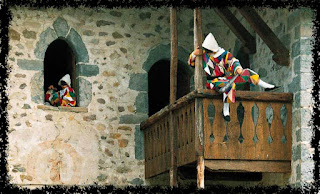
La Compagnia The commedia dell'arte festival during the Carnevale, was an international event that also included two different countries: France and Rumania. Because I arrived during the second week of the festival, I missed the theatre presentation from Rumania, which only participated in the festival during the first week. Luckily, France was there for the second and third week so I had the opportunity to see their show.  "Il trionfo di Arlecchino" was presented by Amata Compagnie/Campagnia Amata (Amata Theatre Company) under the direciton of Carlo Boso (Carlo Boso is an Italian playwright and an international Commedia dell'arte figure living in France.)  La Compagnia What I truly loved about this theatre production was the fact that the play included French, Italian, and English. And all the actors spoke the three languages with ease. Aside from the trilingual acting, the play also included several songs in English, French, and Italian, several dance sequences, pan...

00014: LA CASA DI CARLO GOLDONI

Image
Carlo Goldoni Carlo Goldoni was an Italian playwright born in Venice in 1707. When he was a young man, his father, a doctor, moved to Perugia and then to Remini. It was there that Carlo Goldoni studied philosophy and law, fields that bored him for even as a child Goldoni was interested in theatre.  An opportunity came to Goldoni when he came in contact with the head comedian of the Venetian theater group, Sam Samuele. It is at this moment that Goldoni abandoned his studies, and moved back to Venice where his writing career started.  Although Goldini is know for his incredible body of work, ranging from tragedies to comedies and from operas to poetry, his major contribution to theatre is the fact that he reformed Commedia dell'arte. During the 17th century, commedia was the theatre everyone watched. It consisted of improvisational dialogue while telling well-known stories, filled with stocked characters. But, by the early 18th century, commedia "degenerated into mere buffoonery...